OBPP License in India: SEBI Rules for Safer Bond Investing


A practical guide to understanding the OBPP framework, platform safeguards and the checks investors should complete before buying listed bonds online.
India’s listed bond market has become easier to access online, but easier access is not the same as investor protection.
A high coupon, familiar issuer name or polished digital dashboard does not tell you whether the platform facilitating the transaction operates within a recognised regulatory framework.
That is why the Online Bond Platform Provider framework matters. The expression “OBPP license” is commonly used to describe the regulatory status required for operating as an Online Bond Platform Provider under the applicable securities-market framework.
For investors comparing listed bonds, non-convertible debentures and fixed deposits , understanding the OBPP framework can help distinguish regulated digital bond access from informal or unclear distribution arrangements.
1. OBPP License in India: Meaning, Full Form and Scope
OBPP stands for Online Bond Platform Provider.
In practical terms, an OBPP is a digital platform that enables investors to discover, compare and transact in eligible debt securities through the applicable regulated market infrastructure.
The OBPP framework was introduced to bring greater structure and accountability to online bond distribution. Before the framework developed, digital bond access could involve private networks, relationship-led selling or platforms whose exact regulatory role and grievance process were not always clear to investors.
An entity operating as an OBPP must function within the applicable SEBI and recognised stock-exchange framework and comply with requirements relating to disclosures, investor onboarding, transaction handling, record maintenance and grievance redressal.
Key point: An OBPP is not simply a website displaying bond yields. It is a regulated access layer through which eligible listed debt securities may be discovered and transacted.
2. Why SEBI’s OBPP Framework Matters
Fixed-income products are sometimes described as simple interest-earning investments. Listed bonds, however, can involve several distinct risks:
- Issuer credit risk
- Interest-rate and market-price risk
- Liquidity risk
- Documentation and structural risk
- Call, put or early-redemption risk
- Reinvestment and concentration risk
When a bond is distributed informally, investors may see the most attractive features—such as the coupon, indicative yield, issuer name or maturity—without receiving equal visibility into the instrument’s risks.
Important information such as the latest rating rationale, secondary-market liquidity, security structure, call provisions, debenture-trustee details and applicable risk factors can be overlooked.
The OBPP framework adds process-level guardrails. These guardrails can improve platform accountability and transaction transparency, but they do not convert a risky bond into a safe investment.
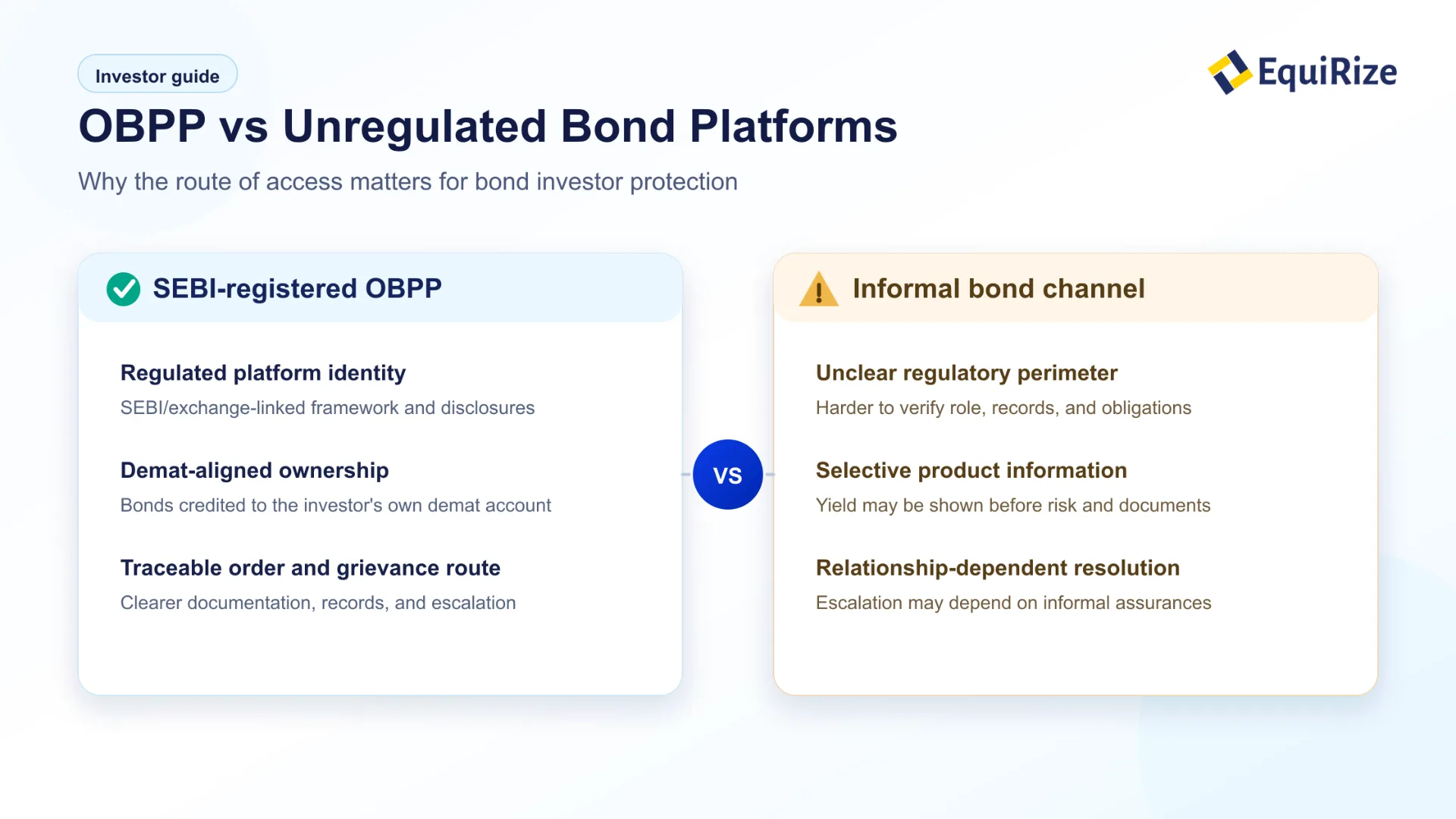
3. SEBI-Registered OBPP vs Informal Bond Distribution
The following comparison explains how a regulated OBPP route can differ from an informal or unclear distribution arrangement.
| Factor | SEBI-Registered OBPP | Informal or Unclear Channel |
|---|---|---|
| Regulatory framework | Operates under applicable SEBI and exchange-linked requirements | Regulatory role may be unclear or outside the OBPP framework |
| Product information | Key instrument details and disclosures should be made available | Information may be selective, incomplete or sales-led |
| Transaction route | Eligible transactions use the applicable recognised market infrastructure | May rely on manual, private or insufficiently documented processes |
| Transaction records | Platform and transaction records should be maintained | Documentation quality and availability may vary |
| Demat holding | Successfully settled listed bonds are generally credited to the investor’s Demat account | Ownership and custody arrangements may be harder to verify |
| Grievance process | Defined platform and regulatory escalation channels | Resolution may depend primarily on the distributor relationship |
| Risk implication | Provides stronger process, disclosure and conduct guardrails | May involve greater information and operational uncertainty |
These differences can matter when an investor later needs transaction records, proof of ownership, support with settlement or access to an established grievance channel.
4. How an Online Bond Platform Provider Works
The platform interface may appear simple, but a listed bond transaction involves several stages.
Step 1: Complete KYC and Demat-Based Onboarding
The investor completes the applicable KYC, identity, bank and Demat-account verification requirements. Listed bonds are securities, so the investor’s legal identity and account details must align with the transaction.
Step 2: Compare the Available Bonds
Investors may compare eligible securities using information such as:
- Issuer name and ISIN
- Credit rating and latest rating rationale
- Coupon rate and payment frequency
- Market price and total amount payable
- Minimum investment amount
- Maturity date
- Security status
- Indicative yield to maturity
Step 3: Review the Yield Carefully
Yield to maturity is an estimated annualised return based on the purchase price, remaining cash flows and time to maturity. It is not a guaranteed return and generally assumes that scheduled payments are made and the bond is held until maturity.
Step 4: Place and Settle the Order
The investor authorises the transaction through the supported process. Subject to successful execution and settlement, the bond units are transferred through the applicable market infrastructure.
Step 5: Monitor the Investment
After purchase, the investor should monitor coupon dates, maturity, issuer disclosures, rating changes and relevant corporate actions. A platform may help organise this information, but the investor remains responsible for reviewing the bond’s continuing risk.
5. Demat Holding in OBPP Bond Transactions
After successful execution and settlement, eligible listed bond units are generally credited to the investor’s Demat account.
Demat holding is important for three reasons:
- Ownership records: The holding is recorded through the depository system instead of relying only on a platform screenshot or distributor confirmation.
- Independent verification: Investors may verify their holding through their Depository Participant or the applicable depository statement.
- Custody separation: The online platform facilitates access but does not become the beneficial owner of the investor’s settled bond units.
Demat holding helps establish ownership, but it does not protect the investor from an issuer delaying or failing to make coupon or principal payments.
6. What the OBPP Framework Helps Protect Against
The OBPP framework is best understood as a set of guardrails around platform conduct and transaction processes.
- Regulatory accountability: The platform operates within a defined regulatory and exchange-linked structure.
- Disclosure discipline: Relevant instrument details and risk disclosures should be available for investor review.
- Transaction traceability: Order, execution and settlement records are more clearly documented.
- Role clarity: Investors can distinguish the platform facilitating access from the issuer responsible for repayment.
- Grievance escalation: Investors have access to defined platform and regulatory escalation mechanisms.
The platform provides the access route. The issuer remains responsible for meeting the bond’s coupon and principal obligations.
7. What an OBPP Registration Does Not Guarantee
A common mistake is assuming that a bond displayed by a SEBI-registered platform automatically becomes low-risk.
An OBPP registration does not:
- Remove issuer credit risk
- Guarantee coupon or principal payments
- Guarantee secondary-market liquidity
- Prevent a credit-rating downgrade
- Guarantee that the quoted market price will remain available
- Make every bond suitable for every investor
- Replace investment, legal or tax advice
- Represent SEBI’s endorsement of an issuer or security
Platform Risk and Instrument Risk Are Different
Platform risk asks whether the transaction route is regulated, transparent, documented and accountable.
Instrument risk asks whether the issuer can meet its obligations and whether the bond’s structure, maturity and liquidity fit the investor’s requirements.
The OBPP framework provides guardrails for the first question. The second question still requires independent bond due diligence.
8. Listed Bonds Through an OBPP vs Fixed Deposits
Fixed deposits and listed bonds may both form part of a fixed-income allocation, but they are different products with different legal structures and risks.
| Comparison | Fixed Deposit | Listed Bond or NCD |
|---|---|---|
| Legal form | Deposit | Debt security |
| Return measure | Stated interest rate | Coupon and indicative YTM |
| Holding format | Deposit account or receipt | Generally held in Demat form |
| Early exit | Premature-withdrawal conditions may apply | Depends on market liquidity, buyer availability and price |
| Primary risks | Institution strength, product terms and applicable withdrawal conditions | Issuer credit, market price, liquidity and instrument structure |
| Review required | Rate, tenure, institution and premature-withdrawal conditions | Issuer, rating rationale, YTM, maturity, liquidity, security and documents |
The relevant question is not whether bonds are universally better than fixed deposits. It is whether the additional potential return adequately compensates for the additional credit, liquidity and structural risks.
9. How to Choose a SEBI-Registered Bond Platform
Verify the Platform’s Regulatory Details
Check the platform’s legal entity name, regulatory registration details, exchange-related information, compliance contact and grievance process. Where available, verify its status through the relevant official records.
Check Whether Product Categories Are Clearly Separated
Listed bonds, NCDs, government securities, bank fixed deposits and corporate fixed deposits should not be presented as interchangeable products merely because they fall within the broader fixed-income category.
Review the Available Bond Information
The platform should provide access to relevant information such as the issuer, ISIN, coupon, maturity, rating, transaction price, indicative yield, security status, minimum investment and applicable issue documents.
Examine the Risk Disclosures
Effective risk communication should explain credit, liquidity, interest-rate, reinvestment and concentration risks. It should not describe fixed income as automatically stable or guaranteed.
Review Post-Investment Support
Investors should be able to access transaction records, holdings information, relevant documents and official support or grievance channels after completing a purchase.
10. Bond Due-Diligence Checklist for OBPP Investors
- Confirm the issuer: Review the borrower’s exact legal name, business, financial position, existing debt and use of proceeds.
- Match the ISIN: Confirm that the ISIN shown on the platform matches the instrument documents.
- Read the latest rating rationale: Review the rating, outlook, date, rating history, strengths and identified credit risks.
- Compare coupon and YTM: Understand why the indicative yield may differ from the coupon rate.
- Check the maturity: Align the maturity and cash-flow schedule with the date on which you may need the money.
- Understand the security: Check whether the bond is secured, unsecured, senior or subordinated.
- Review call and put provisions: Check whether the issuer or investor can seek redemption before final maturity.
- Evaluate liquidity: Do not assume that listing guarantees an immediate exit at the displayed price.
- Limit concentration: Consider how much of your portfolio is exposed to the same issuer, group, sector or maturity period.
- Read the complete documents: Review the term sheet, offer or placement document, rating rationale and applicable risk factors.
11. Exploring Listed Bonds Through EquiRize
EquiRize provides digital access to listed fixed-income opportunities through a regulated platform workflow.
Investors can use the platform to review available instrument information such as the issuer, indicative yield, credit rating, coupon frequency, maturity, security status and minimum investment amount.
The platform interface can make bond discovery and comparison more organised, but investors should still read the applicable issuer and instrument documents before making a decision.
Investors can explore listed bonds on EquiRize and compare fixed-income options before making an allocation decision.
12. Red Flags Before Buying Bonds Online
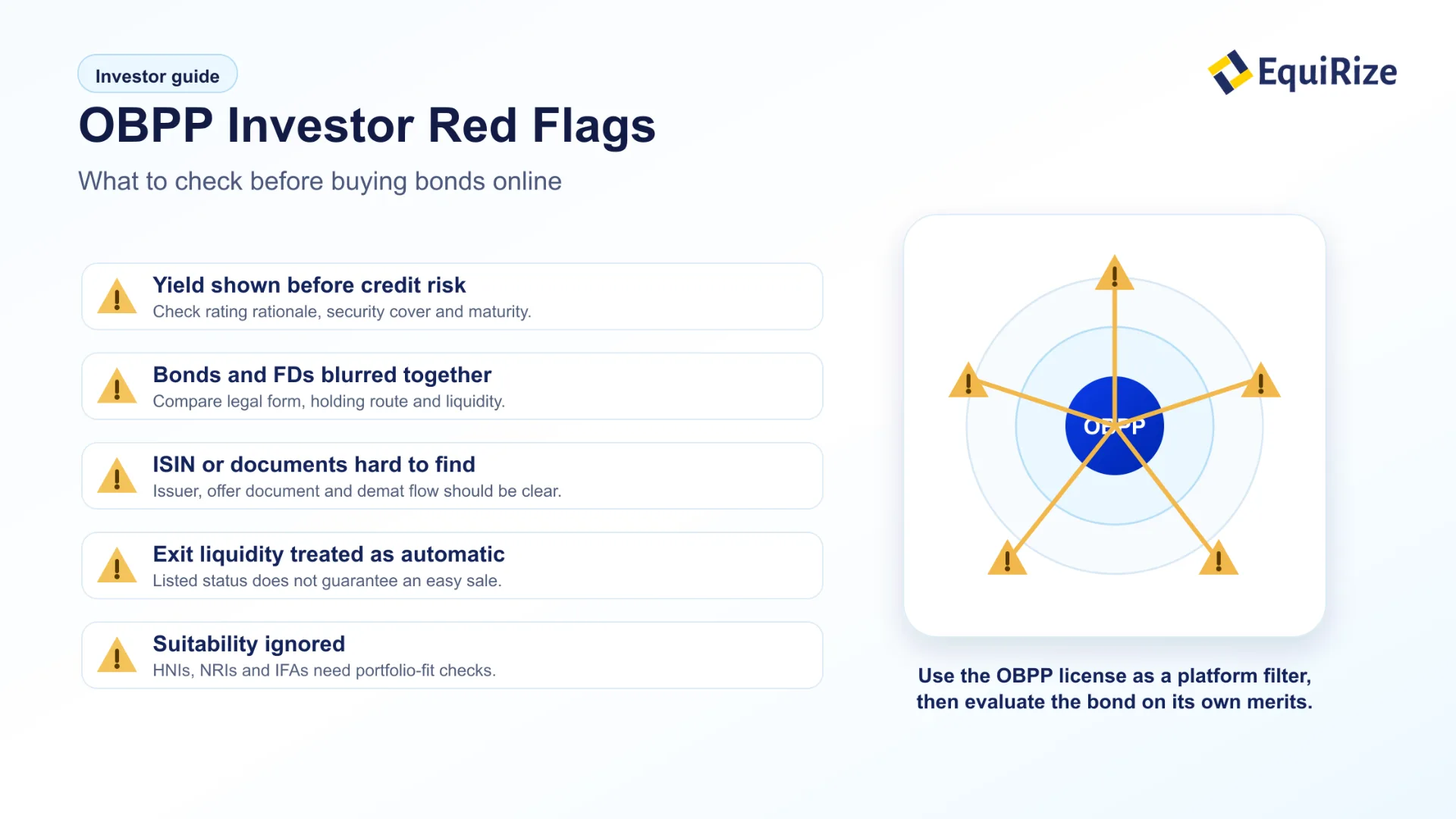
Red Flag 1: Yield Is More Prominent Than Credit Risk
If the potential yield is highly visible but the issuer’s credit profile is difficult to find, pause before investing. Higher yield may compensate for greater credit, liquidity, tenure or structural risk.
Red Flag 2: Bonds and Fixed Deposits Are Presented as Identical
Bonds, NCDs, bank fixed deposits and corporate fixed deposits have different legal structures, holding formats, exit routes and risk characteristics.
Red Flag 3: ISIN and Issue Documents Are Difficult to Find
Investors should be able to identify the issuer, ISIN, coupon schedule, maturity, rating, security structure and applicable instrument documents.
Red Flag 4: Secondary-Market Exit Is Presented as Automatic
A listed bond may still have limited trading activity. A buyer may not be available immediately, and the executable price may differ from the last displayed price.
Red Flag 5: Investor Suitability Is Ignored
Suitability depends on the investor’s objectives, liquidity requirements, financial position, risk tolerance, tax circumstances and portfolio concentration. The same bond may not be appropriate for every investor.
Key Takeaway
The OBPP framework is an important starting filter when choosing an online bond platform in India.
It indicates that the platform operates within a SEBI-linked framework with defined requirements relating to disclosures, records, transaction processes and investor grievance channels.
However, the platform’s regulatory status is not a substitute for bond due diligence.
Before investing, compare relevant alternatives, understand the coupon and indicative YTM, review the issuer’s credit quality and confirm that the maturity aligns with your requirements.
Explore Listed Bonds on EquiRize
Review available listed bonds using information such as issuer, credit rating, indicative yield, maturity, coupon frequency and security status.
Read the applicable term sheet, offer document, latest rating rationale and risk factors before investing.
Explore Listed BondsRisk Disclosure
Investments in listed corporate bonds and other debt securities are subject to market risks, including credit risk, interest-rate risk and liquidity risk.
Bond prices may fluctuate, and investors may not be able to sell an investment before maturity at the original purchase price. Listing on a stock exchange does not guarantee liquidity.
Scheduled coupon and principal payments remain subject to the issuer meeting its obligations. Returns and repayment are not guaranteed. Credit ratings are opinions regarding credit risk and are not recommendations to buy, sell or hold a security.
SEBI Non-Endorsement Disclosure
Registration with SEBI or a stock exchange does not constitute approval, endorsement or guarantee of EquiRize, any security displayed on the platform or any investment outcome.
Educational Disclaimer
This content is provided solely for general informational and educational purposes. It does not constitute investment, tax or legal advice, an offer or a solicitation to invest.
Investors should evaluate their objectives, financial situation, time horizon and risk tolerance and consider consulting an appropriately registered adviser before making an investment decision.
EquiRize Securities Private Limited
SEBI Registration Number: INZ000323730
BSE Debt Segment Membership No.: 6914
NSE Debt Segment Membership No.: 90472