Investing in Bonds in India With ₹10,000: Starter Guide



A first-time investor’s guide to understanding smaller-ticket listed bonds, comparing them with fixed deposits and reviewing the risks before investing.
For many Indian professionals, the first fixed-income decision is automatic: renew the fixed deposit, compare two bank rates and move on.
Direct bond investing was historically associated with institutions, wealth-management desks and relatively large investment amounts. Smaller denominations have now made some listed debt securities more accessible to individual investors.
Subject to the instrument’s face value, issue terms, trading lot, availability and investor eligibility, investing in eligible listed bonds may begin with an amount around ₹10,000 .
This guide explains how smaller-ticket access works, how listed bonds differ from fixed deposits, what an Online Bond Platform Provider does and what investors should review before placing an order.
Explore Listed Bonds on EquiRize
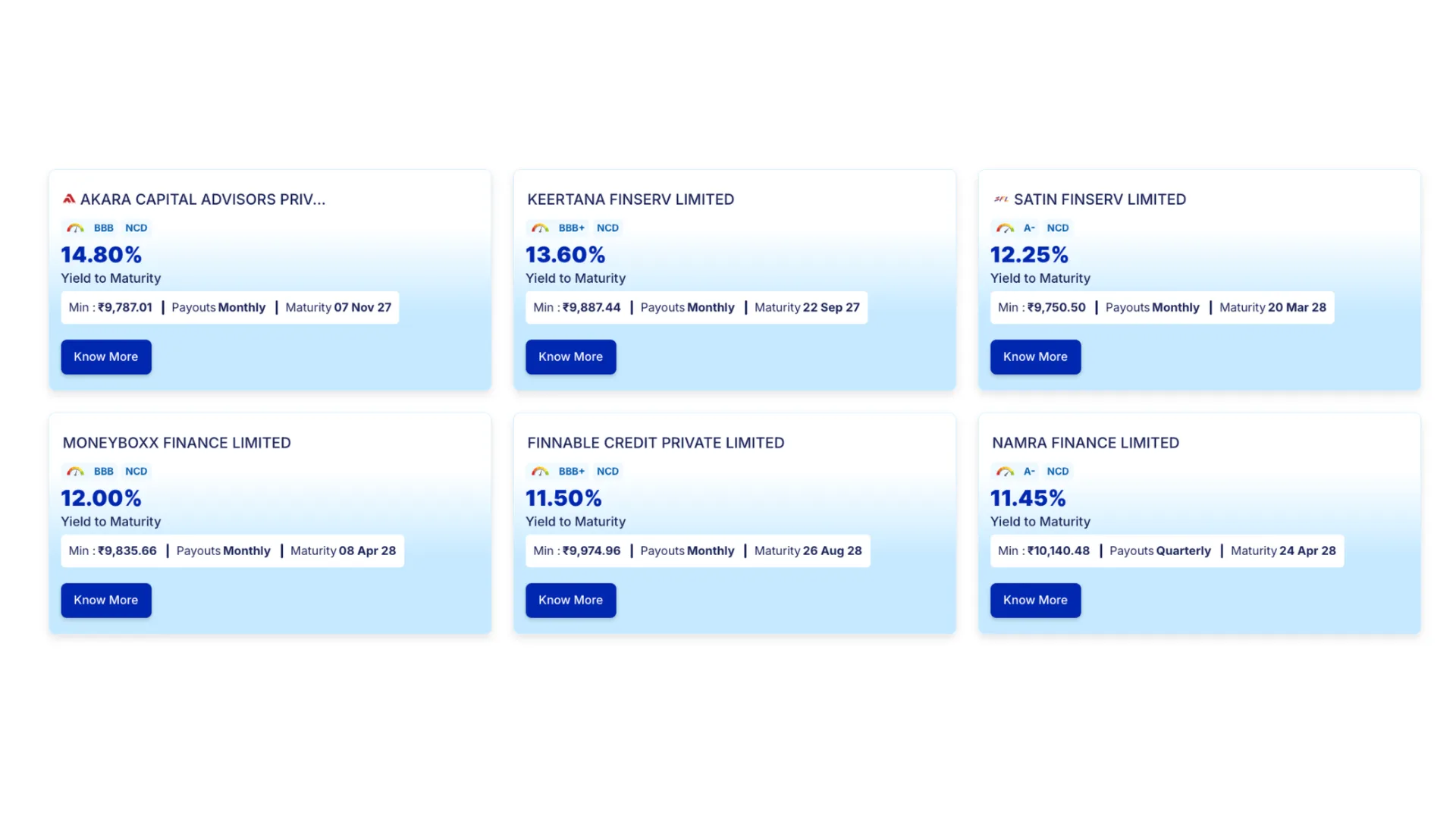
Review available instruments using information such as issuer, credit rating, maturity, coupon frequency and indicative yield.
Explore Listed Bonds →Can You Start Investing in Bonds With ₹10,000?
The answer is yes for certain eligible instruments, but the ₹10,000 figure needs to be understood carefully.
Not every listed bond has a face value of ₹10,000, and a bond with a ₹10,000 face value may not always be available for exactly ₹10,000.
The final transaction amount can depend on:
- The bond’s face value
- Issue or secondary-market price
- Trading lot and available quantity
- Accrued interest, where applicable
- Transaction-related components
- Investor eligibility and product availability
Important: ₹10,000 should be understood as a possible entry point for eligible instruments—not as a universal minimum investment for every listed bond.
Smaller Ticket Size Does Not Mean Lower Risk
A smaller allocation reduces the absolute amount invested, but it does not change the bond’s underlying credit, liquidity, market or structural risks.
An investment of ₹10,000 and an investment of ₹10 lakh in the same bond are exposed to the same issuer and instrument-level risks. The difference is the investor’s absolute rupee exposure.
Why Smaller Ticket Sizes Matter
The primary change is improved accessibility. Investors may be able to study and participate in the listed corporate bond market without making a significantly larger initial allocation to one instrument.
Smaller Initial Allocation
A smaller ticket size may allow a first-time investor to begin with a more limited absolute exposure while learning how bond pricing, coupon payments, Demat credit and maturity work.
Greater Scope for Diversification
Where suitable instruments are available, smaller denominations may help investors spread a fixed-income allocation across different issuers, sectors or maturity dates.
Diversification depends on the actual issuers, sectors, maturities and structures selected. Simply holding several bonds does not automatically create a well-diversified portfolio.
How to Invest in Corporate Bonds in India
The investment journey is digital, but it still requires identity verification, a Demat account and issuer-level due diligence.
Documents and Accounts You May Need
An investor generally needs:
- PAN
- Completed KYC
- An active Demat account
- A verified bank account
- Access to the mobile number or email required for authentication
Subject to successful execution and settlement, the bond units are generally credited to the investor’s own Demat account.
The investor is not placing money in a deposit operated by the platform. The investor is purchasing or subscribing to a debt security issued by the relevant issuer, according to the instrument’s terms.
What Happens on a SEBI-Registered Bond Platform?
A SEBI-registered Online Bond Platform Provider may help investors:
- Review available listed debt securities
- Compare relevant instrument information
- Access issuer and instrument documents
- Complete the applicable onboarding process
- Place an eligible transaction through the supported route
- Access transaction records and support channels
EquiRize is a SEBI-registered Online Bond Platform Provider. It facilitates access to eligible listed debt securities. It is not the issuer of the bonds displayed on the platform and does not provide investment advice.
Bonds vs Fixed Deposits: What Changes for the Investor?
Bonds and fixed deposits are both considered within the wider fixed-income category, but they have different legal structures, liquidity conditions and risk characteristics.
| Comparison | Bank Fixed Deposit | Listed Corporate Bond |
|---|---|---|
| Legal structure | Deposit placed with a bank | Debt security issued by a company or eligible institution |
| Return measure | Stated interest rate | Coupon rate and indicative Yield to Maturity |
| Holding format | Deposit account or receipt | Generally held in Demat form |
| Early access | Premature-withdrawal terms and penalties may apply | Exit depends on buyer availability, market liquidity and executable price |
| Primary risk | Institution strength and applicable deposit terms | Issuer credit, interest-rate, market-price, liquidity and structural risks |
| Investor review | Rate, tenure, premature-withdrawal conditions and institution | Issuer, rating rationale, YTM, maturity, liquidity, security and documents |
Deposit Insurance and Bond Risk
Eligible bank deposits are insured by the Deposit Insurance and Credit Guarantee Corporation up to the applicable limit and subject to its conditions.
Listed corporate bonds are not covered by bank-deposit insurance. Coupon and principal payments depend on the issuer meeting its obligations.
A higher indicative bond yield should therefore be evaluated alongside the additional credit, liquidity, market and structural risks involved.
Compare Bonds and Fixed Deposits
Compare their structure, maturity, access conditions and risk characteristics before selecting a fixed-income option.
Compare Fixed-Income Options →How a SEBI-Registered Bond Platform Works
A SEBI-registered Online Bond Platform Provider operates within the applicable OBPP framework.
This framework brings digital bond access within a defined regulatory perimeter. It does not remove the investment risks associated with the issuer or instrument.
Information the Platform Should Make Available
Before placing an order, investors should be able to review relevant details such as:
- Issuer’s legal name
- Instrument type and ISIN
- Face value and transaction price
- Minimum investment amount
- Coupon rate and payment frequency
- Maturity date
- Credit rating and rating agency
- Indicative Yield to Maturity
- Security status
- Offer documents and applicable risk factors
What SEBI Registration Does Not Mean
Registration as an OBPP does not mean that SEBI approves, endorses or guarantees any particular issuer, bond or investment outcome.
The framework defines the platform’s operating perimeter. The bond’s repayment risk remains connected to the issuer, instrument structure and terms.
What Should You Check Before Investing?
Before placing an order, investors should complete a short but disciplined review. The objective is not to eliminate risk; it is to understand the risk being accepted.
- Confirm the issuer: Check the company’s exact legal name, business model, financial position, existing debt and use of proceeds.
- Match the ISIN: Ensure that the ISIN displayed in the transaction summary matches the intended bond.
- Read the rating rationale: Review the latest rating, outlook, date, rating history and risks identified by the rating agency.
- Compare coupon and YTM: Understand that the coupon rate and indicative Yield to Maturity are not the same.
- Check the maturity: Align the maturity date with the date on which the money may be required.
- Review the security structure: Check whether the bond is secured, unsecured, senior or subordinated.
- Examine liquidity: Do not assume that exchange listing guarantees an immediate exit at the desired price.
- Consider tax: Compare the estimated post-tax outcome—not only the displayed coupon or yield.
- Limit concentration: Avoid placing an excessive proportion of the portfolio with one issuer, group, sector or maturity period.
- Read the documents: Review the offer document, term sheet, rating rationale and applicable risk factors.
Coupon Rate Is Not the Same as Yield to Maturity
The coupon rate determines the scheduled interest payment with reference to the bond’s face value.
Yield to Maturity is an estimated annualised return calculated using factors such as the transaction price, remaining coupon payments, redemption amount and time to maturity.
YTM is not guaranteed. It generally assumes that scheduled payments are made and that the bond is held until maturity.
Bond Investing for Salaried Professionals
For salaried professionals, listed bonds may form part of the non-equity allocation of a broader portfolio.
Potential reasons for reviewing listed bonds may include:
- Defined maturity dates
- Scheduled coupon cash flows
- Diversification away from equity-market volatility
- The ability to compare multiple issuers and maturity periods
- A possible role within a goal-based fixed-income allocation
The allocation should remain consistent with the investor’s emergency liquidity, financial goals, existing fixed-income exposure and ability to accept credit and liquidity risk.
What Should NRI Investors Verify?
NRI eligibility can depend on the specific security, account structure, KYC status, banking arrangement and applicable regulatory requirements.
Before proceeding, an NRI investor should verify:
- Whether the instrument is available for NRI investment
- The required bank-account and Demat-account structure
- Whether the platform supports the applicable onboarding route
- Relevant FEMA requirements
- Tax treatment and withholding requirements
- Repatriation and documentation conditions, where applicable
NRI investors should consider obtaining professional tax and legal guidance based on their residency status and individual circumstances.
How to Approach a First ₹10,000 Bond Allocation
A first allocation should not be selected only because the visible yield appears attractive.
Start With the Purpose of the Money
Determine whether the money is intended for a near-term requirement, a specific financial goal or a longer-term fixed-income allocation.
The purpose of the money helps determine the appropriate maturity and the amount of liquidity that should remain outside the bond allocation.
Compare Similar Instruments on the Same Basis
Avoid comparing bonds only by headline yield. Review rating, issuer profile, maturity, coupon frequency, security structure, liquidity and post-tax outcome.
Consider Maturity Staggering as the Portfolio Grows
As an investor builds a larger fixed-income allocation, spreading maturities across different dates may help reduce concentration around one reinvestment period. Maturity staggering does not remove issuer or liquidity risk.
Common Mistakes to Avoid
Looking Only at the Coupon or Indicative Yield
A higher coupon or indicative yield may reflect greater credit risk, longer tenure, lower liquidity, structural complexity or weaker market demand.
Treating the Credit Rating as a Guarantee
A credit rating is an opinion regarding relative credit risk. It is not a guarantee of repayment and can be revised or withdrawn.
Assuming Listing Guarantees Liquidity
A bond being listed on a stock exchange does not guarantee that a buyer will be available immediately or at the investor’s preferred price.
Ignoring Tax Before Investing
The post-tax outcome can differ from the headline coupon or indicative pre-tax yield. Tax treatment depends on the investor’s circumstances and applicable law.
Investing Without Reading the Documents
Platform summaries can support comparison, but they should not replace the applicable offer document, term sheet, rating rationale and risk disclosures.
Key Takeaway
Starting with approximately ₹10,000 can make certain listed bonds more accessible, but ticket size is not the best measure of investor readiness.
The more important question is whether the investor understands the issuer, rating, maturity, coupon schedule, liquidity, security structure, tax treatment and applicable documents.
Smaller investment amounts improve access. They do not create a separate, lower-risk category of listed bonds.
Conclusion
Investing in bonds with approximately ₹10,000 should be viewed as a more accessible entry point into listed fixed income—not as a shortcut around due diligence.
Listed bonds may play a role within the non-equity portion of a portfolio when selected according to the investor’s goals, liquidity requirements, time horizon and risk capacity.
A SEBI-registered Online Bond Platform Provider such as EquiRize can help investors explore listed bond opportunities through a regulated access framework. Investors should still review the applicable issuer and instrument documents before making a decision.
Ready to Explore Listed Bonds?
Review the issuer, rating, maturity, coupon schedule and applicable documents before making an investment decision.
Explore Listed Bonds →Review all applicable issuer and instrument documents before investing.
Risk Disclosure
Investments in listed corporate bonds and other debt securities are subject to market risks, including credit risk, interest-rate risk, liquidity risk and default risk.
Bond prices may fluctuate, and investors may not be able to sell an investment before maturity at the original purchase price. Listing on a stock exchange does not guarantee liquidity.
Scheduled coupon and principal payments remain subject to the issuer meeting its obligations. Returns and repayment are not guaranteed. Credit ratings are opinions regarding credit risk and are not recommendations to buy, sell or hold a security.
SEBI Non-Endorsement Disclosure
Registration with SEBI or a stock exchange does not constitute approval, endorsement or guarantee of EquiRize, any security displayed on the platform or any investment outcome.
Educational Disclaimer
This content is provided solely for general informational and educational purposes. It does not constitute investment, legal or tax advice, an offer or a solicitation to invest.
Investors should evaluate their objectives, financial situation, time horizon and risk tolerance and consider consulting appropriately qualified advisers before making an investment decision.
EquiRize Securities Private Limited
SEBI Registration Number: INZ000323730
BSE Debt Segment Membership No.: 6914
NSE Debt Segment Membership No.: 90472